Song Meaning
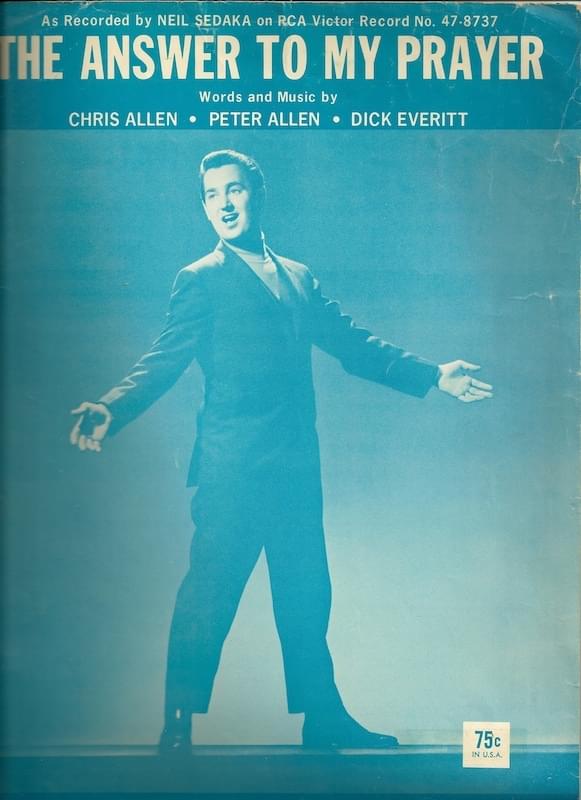
Neil Sedaka's "The Answer To My Prayer" isn't just a love song; it's a carefully constructed narrative of faith, yearning, and the perceived divine sanction of romantic union. The lyrics, delivered with Sedaka's signature earnestness, paint a picture of two individuals who have actively petitioned a higher power for their ideal partner. The phrase 'answer to my prayer' is repeated not as a casual sentiment, but as the core validation of their bond. This isn't just about finding love; it's about finding love that feels preordained, blessed, and therefore, inherently more secure. The invocation of childhood dreams and nightly prayers underscores the depth of this longing, suggesting that the desire for this specific connection has been a lifelong pursuit. The song subtly plays into the psychological comfort of confirmation bias, where the intensity of the initial desire amplifies the perceived 'rightness' of the relationship.
From a lyrical standpoint, the song employs a clever mirroring structure. Both the 'young girl' and the 'young man' express their history of prayer, creating a symmetrical narrative of shared spiritual preparation. This symmetry reinforces the idea of compatibility, suggesting that they were not only praying for love but for each other, unknowingly. The song avoids specific details about the individuals themselves, which allows listeners to project their own experiences and fantasies onto the narrative. This ambiguity enhances the song's universality, making it less about a specific couple and more about the idealized concept of divinely ordained love. The simplicity of the language is key here; it mirrors the perceived simplicity of faith itself.
However, the song also flirts with the potential pitfalls of such intense idealization. By framing the relationship as a direct answer to prayer, the song sets an incredibly high bar. The implication is that this love should be perfect, effortless, and free from the ordinary challenges of human relationships. While the song celebrates the joy of finding a partner, it simultaneously hints at the pressure of living up to a divine expectation. The line, 'Everything I wanted God only knew,' underscores the specificity of their desires, potentially creating a rigid framework that could become stifling over time. Ultimately, "The Answer To My Prayer" is a fascinating exploration of the intersection between faith, desire, and the human need to find meaning and validation in romantic love. It is a testament to the power of belief, both in a higher power and in the transformative potential of love itself.
 View Artist