Song Meaning
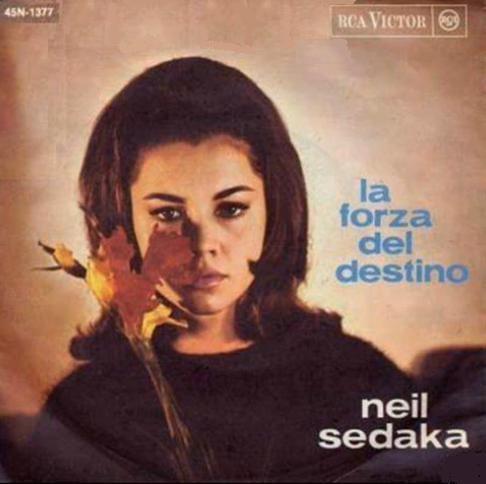
Neil Sedaka's "La Forza Del Destino" isn't just a song; it's a declaration of preordained love, a romantic manifesto set to music. The title itself, borrowed from Verdi's opera, signals a grand, sweeping narrative of fate. But instead of operatic tragedy, Sedaka channels that sense of destiny into an unwavering affirmation of devotion. The lyrics, sung in Italian, repeatedly emphasize the unbreakable bond between two souls, united not by chance, but by the very force of destiny itself. It speaks to a deep-seated human desire to believe that some connections are simply meant to be, impervious to external forces. There is an interesting psychological play here, a self-fulfilling prophecy fueled by intense emotion and the almost primal need to believe in a 'one true love.'
The repeated assurances – "nessuno ci può più separar" (no one can separate us anymore) and "per sempre ci unirà" (will unite us forever) – aren't just romantic tropes; they're attempts to solidify a feeling, to ward off doubt by sheer force of will. The singer seems to be convincing himself as much as his beloved. The lyrics hint at a potential for external threats or internal insecurities, anxieties that are being actively suppressed by the insistent repetition of unwavering commitment. The phrase "È scritto nel domani" (It is written in tomorrow) suggests a relinquishing of control, a surrender to a predetermined path, which, paradoxically, provides comfort and security.
The simplicity of the language, the almost childlike repetition of "Io ti amo lo sai / Che mai e poi mai / Ti lascerò" (I love you, you know / That never and never / I will leave you), amplifies the raw emotion. It strips away any pretense, leaving only the core declaration of love and loyalty. The song isn't about the complexities of a relationship; it's about the foundational belief in its invincibility. It is an anthem for anyone who has ever felt that their love was not just a choice, but an inevitability, written in the stars, a force of nature.
 View Artist