Song Meaning
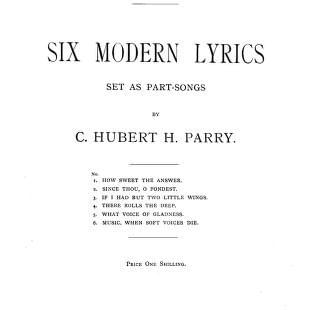
The lyrics paint a stark contrast between earthly sorrow and celestial joy, immediately establishing a tone of longing. A "voice of gladness" rings out, but the immediate sensory experience is of "sad fields" and a "mournful mist" that obscures the day. This sets up a central tension: the desire to connect with a higher, happier state while being grounded in present unhappiness.
The core conflict emerges as the narrator observes the larks. These birds, initially described as "upward winging" through the "mournful mist," are revealed to be "soaring in the grey." Yet, the lyrics quickly pivot, revealing that the larks are actually "In sunlight swim; above the furthest stain / Of cloud." This suggests the birds' true experience of joy and freedom exists beyond the narrator's immediate, clouded perception, creating a poignant distance.
The most striking craft element is the juxtaposition of sensory details. The "mournful mist" and "grey" are directly contrasted with the "sunlight" and "heaven's best azure." The larks' "songs betray" their location, initially seeming to be within the gloom, but ultimately revealing their ascent to a brighter realm. The repeated idea of birdsong acts as a conduit, a "voice of gladness" that "dome[s] us with joy" even from afar.
These lyrics resonate because they articulate a universal yearning for transcendence. The writing effectively uses the image of birds to represent an unattainable, yet audible, happiness. The shift from the narrator's somber reality to the imagined, sunlit world of the larks creates an emotional arc that is both wistful and hopeful, highlighting how even the faintest echo of joy can offer solace.
 View Artist