Song Meaning
The lyrics paint a picture of decay and existential uncertainty, starting with stark pronouncements like "É crime. É crasso. É o degelo." This initial barrage of negative descriptors, ranging from the abstract "crime" and "crass" to the chilling "monstro glaciar" (glacier monster), establishes a tone of overwhelming, almost elemental, decline. The narrator seems to be cataloging a world that is falling apart, where even seemingly disparate things like a "corte de cabelo" (haircut) and a "árvore milenar" (ancient tree) are subject to this pervasive rot.
This sense of decline is amplified by the narrator's own internal state, where identity and possession become fluid and uncertain. The lines "Eu sei / Que o tempo aqui já só me traz refém" (I know / That time here only makes me a hostage) reveal a feeling of being trapped by the passage of time, unable to escape its corrosive effects. This is compounded by the admission "E o que eu sou nem sei" (And what I am, I don't even know), suggesting a loss of self amidst the external decay. The "traça" (moth) waiting to consume what has been accumulated becomes a potent image of inevitable entropy.
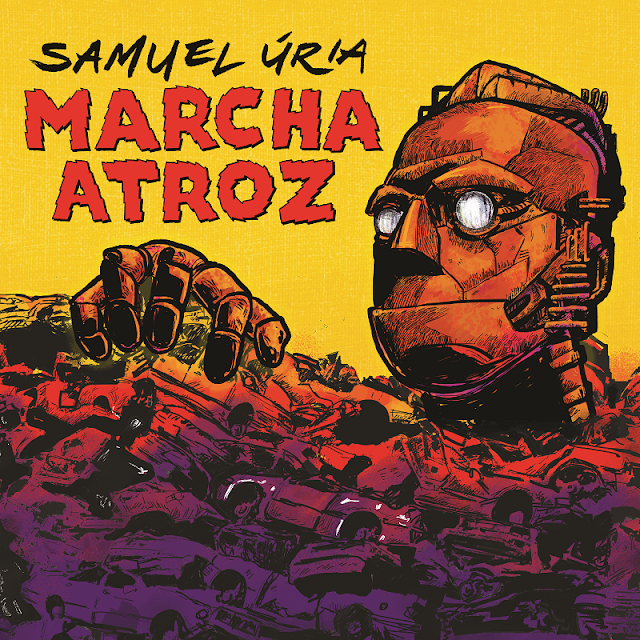
The lyrical craft relies heavily on a relentless enumeration of contrasting or seemingly unrelated concepts, creating a disorienting effect that mirrors the narrator's confusion. Phrases like "É pouco. É tanto. É meio termo" (It's little. It's much. It's a middle ground) and the juxtaposition of "É pau. É pedra." (It's wood. It's stone.) with "É rock impopular" (unpopular rock) highlight a world where extremes and middles alike are succumbing to the same fate. The recurring motif of "ferrugem" (rust) and the final image of "o que resta já se enferrujou" (what remains has already rusted) powerfully convey the irreversible nature of this decay, both external and internal.
Ultimately, the effectiveness of these lyrics lies in their unflinching portrayal of a world and a self in a state of advanced decomposition. The narrator's resigned acceptance, punctuated by moments of sharp observation, makes the pervasive sense of loss palpable. The writing doesn't offer solace but rather a stark, almost beautiful, depiction of entropy, where even the accumulation of possessions or identity leads only to the inevitable "ferrugem."
 View Artist