Song Meaning
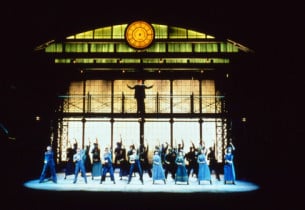
The lyrics present a stark vision of industrial progress, personified by Henry Ford and his assembly line. The narrator, seemingly Ford himself, outlines a theory of national advancement driven by efficient, repetitive labor. This vision is one where "every worker / A cog in motion," a concept that becomes the "notion of / Henry Ford." The repeated phrase "Speed up the belt" underscores the relentless demand for increased output, framing progress as a purely mechanical, accelerated process. The lyrics suggest a future where even those "who ain't too clever" can contribute by performing simple, endless tasks like tightening a nut or pulling a lever, highlighting a dehumanizing aspect of mass production.
The central tension arises from the contrast between the celebratory "Hallelujah / Praise the maker / Of the Model T" from the ensemble and the underlying implication of the worker's role. While the ensemble seems to genuflect to Ford's innovation, the detailed description of individual tasks – "One man tightens / And one man ratchets" – reveals a system that breaks down complex work into isolated, monotonous actions. This structure emphasizes the loss of individual agency, reducing people to interchangeable parts in a larger, ever-moving machine. The car, a symbol of freedom and mobility, is built through a process that appears to restrict the very people creating it.
The most striking craft element is the juxtaposition of grand pronouncements about national progress with the mundane reality of assembly line labor. The ensemble's praise for the "maker of the Model T" is immediately followed by Ford's pragmatic, almost dismissive, instruction: "Even people who ain't too clever / Can learn to tighten a nut forever." This contrast underscores the lyrics' commentary on how technological advancement, while celebrated, can lead to a reduction in the complexity and dignity of human work. The repeated "Henry Ford" chant by the ensemble acts as both an anthem of industrial achievement and a chilling echo of the system's pervasive influence.
Ultimately, these lyrics are effective because they capture a specific historical moment's optimism about industrialization while subtly revealing its human cost. The focus on the mechanical, the repetitive, and the easily learned task paints a picture of a society being reshaped by efficiency. The final lines, with the ensemble's "And climb aboard" and Coalhouse's "I'm ready, Lord," suggest a collective, almost religious, embrace of this new industrial order, leaving the listener to ponder the true nature of this "world's reward."