Song Meaning
The lyrics present a stark, cyclical contemplation of existence and its conclusion. Phrases like "Vita et Mori" (Life and Death) and "Semper Ad Finem" (Always To The End) establish a relentless, almost ritualistic focus on mortality. The repetition of "Vita, mori" hammers home this duality, suggesting that life and death are not separate events but intertwined aspects of a single process. The dominant tone is one of somber acceptance, a quiet acknowledgment of an inevitable path.
The central tension appears to be the transition from one state to another, hinted at by "Ad Regnum Ultra" (To the Kingdom Beyond) and "Simul Porta Transimus" (Together We Pass Through the Gate). This suggests a movement, a crossing over, perhaps from life into whatever follows. The phrase "Juncti Veritas" (United Truth) implies that this passage is shared, a collective experience where truth is found in unity or in the finality of the shared journey. It’s a profound, albeit brief, meditation on the end of things.
The most striking aspect of the craft is the persistent use of Latin, lending the lyrics an ancient, almost liturgical weight. This linguistic choice elevates the themes beyond a personal narrative to something more universal and timeless. The structure, built on repeating motifs and short, declarative phrases, creates a sense of inevitability and finality. The final lines, "Iter Finem Aliud Incipit" (The Journey Ends, Another Begins) and "Vale Domo Nostra" (Farewell Our Home), encapsulate the core idea: an ending that is simultaneously a new beginning, a departure from the familiar into the unknown.
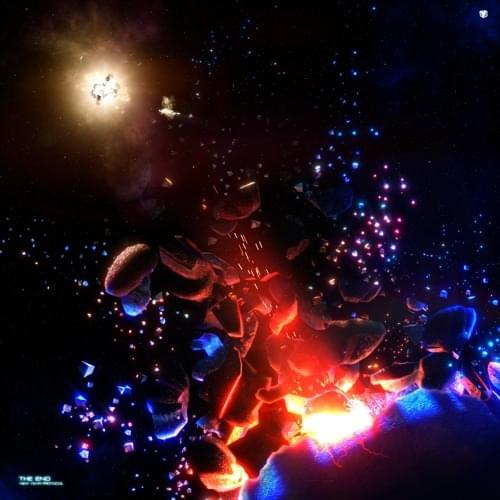
This lyrical construction is effective because it bypasses explicit emotional outpouring for a more profound, intellectual and spiritual resonance. By employing a language that feels both sacred and distant, the lyrics invite the listener to project their own understanding of life, death, and transition onto the stark pronouncements. The cyclical nature and the emphasis on passage create a feeling of profound, quiet closure, making the contemplation of "THE END" feel less like an endpoint and more like a fundamental, ongoing process.
 View Artist