Song Meaning
The lyrics paint a vivid picture of words as potent, almost physical entities, capable of both immense power and utter futility. Initially, "Se disparada pelo amor" (If shot by love) and "Palavra-bala" (bullet-word) establish language as a projectile, sharp and potentially dangerous. This force is contrasted with the silencing effect it has "Na boca do ditador" (In the mouth of the dictator), where "Toda palavra cala" (Every word silences). The repeated plea, "Ô, mama / Cala palavra" (Oh, mama / Silence word), suggests a desire to control or suppress this powerful, perhaps overwhelming, force.
The central tension arises from the dual nature of words: they can be tools of oppression or sources of solace. "Palavra-mala" (baggage-word) and "Pobre palavra rala" (poor, thin word) describe words that fail to connect or be felt, while "Palavra me socorre" (Word rescues me) highlights their ability to provide relief when "o tédio me assaltar" (boredom assaults me). This duality is further explored with "Palavra corre" (Word runs) when one shouts for help, only for "Toda palavra morre" (Every word dies) when desire is absent, indicating that words lose their life force without genuine feeling or connection.
The most striking craft element is the consistent metaphorical extension of "palavra" (word) into compound nouns that describe its function or state. We see "Palavra-bala," "Palavra-mala," "Palavra-porre" (drunken word), "Palavra-malha" (mesh-word), and "Palavra-falha" (failure-word). This technique personifies words, giving them agency and physical attributes, making their impact tangible. The repetition of "Mama palavra" (Mama word) acts as an invocation, a plea to this maternal, life-giving source of language, perhaps seeking its guidance or protection.
Ultimately, these lyrics resonate because they capture the complex relationship we have with language. Words can be weapons, burdens, saviors, or ghosts, their power dependent on context and intent. The imagery of words failing to connect, becoming "palavra-tralha" (junk-word), or being silenced by authority, speaks to the frustration of inarticulateness and oppression, while the idea of words rescuing us offers a powerful affirmation of language's enduring ability to provide meaning and support.
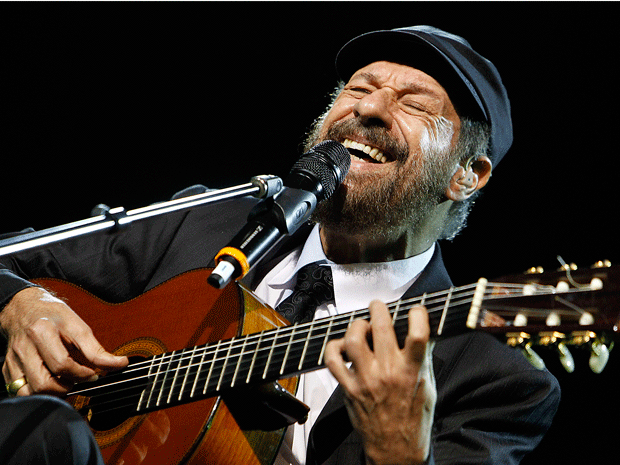
 View Artist