Song Meaning
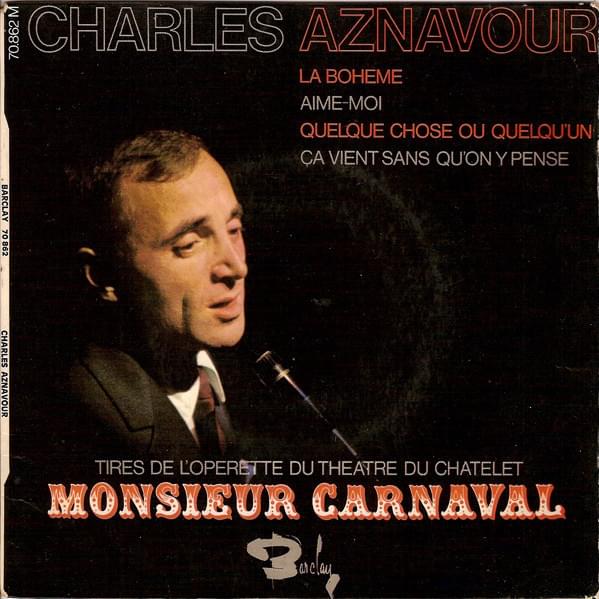
Charles Aznavour's "Aime-moi" isn't merely a plea for affection; it's a raw, exposed nerve of need, demanding not just love, but a specific, all-consuming kind of love. The lyrics pulse with a vulnerability that's almost unsettling, a craving for reciprocal intensity that borders on possessive. Aznavour isn't asking for a casual romance; he's laying bare a profound insecurity, requiring constant reassurance, a mirror reflecting back his own worth through the lover's eyes. The repeated phrase "Aime-moi" ("Love me") acts as both a mantra and a desperate question. The song meaning lies in this paradox: the simultaneous declaration of love and the deep-seated fear of not being enough.
The lyrics hint at a past devoid of the desired affection. Lines like "Comme tu n'as jamais aimé" ("As you have never loved") and "Comme j'ai rêvé d'être aimé" ("As I dreamed of being loved") suggest a yearning born from deprivation, a void that only this idealized, all-encompassing love can fill. He offers everything in return: "Je donnerai n'importe quoi" ("I will give anything"), yet this generosity feels less like a gift and more like a transaction, an attempt to buy the love he so desperately seeks. There's a fragile ego at play here, a sense that his happiness is entirely dependent on the lover's unwavering devotion.
The final verses amplify this dependence. Aznavour doesn't just want to be loved; he wants to be completely integrated into the lover's existence: "Que si je ne me vois dans tes yeux / Dans tes chagrins et dans tes joies / Que si je fais partie de toi" ("Only if I see myself in your eyes / In your sorrows and in your joys / Only if I am part of you"). This isn't a desire for intimacy; it's a demand for absorption, a blurring of boundaries that speaks to a deep-seated fear of abandonment. The song transcends a simple love song, becoming a psychological portrait of need, insecurity, and the desperate search for validation through another's love. It's a love that heals, but also suffocates.
 View Artist