Song Meaning
The lyrics paint a stark picture of urban existence, opening with a raw, almost brutal imperative to "earn the right to live" amidst the crush of Tokyo's Ueno and Akihabara. This dystopian escape narrative is fueled by a rejection of a "postponed life," suggesting a desperate, almost nihilistic drive to survive. The imagery of a "crow's voice" and a "girl's smile" juxtaposed with "sexual inadequacy" and a cramped "6.5 tatami" room highlights a profound disconnect between primal urges and the sterile, confined reality of modern life. The narrator perceives humanity as inherently "anti-social," embracing "blasphemy" and "immorality" as a collective state.
The central tension arises from the conflict between societal platitudes and the narrator's visceral rejection of them. The line "'Cherish yourself,' that's just a platitude, isn't it?" dismisses conventional wisdom as mere self-serving rhetoric. This is amplified by the critique of a "world's debt" that "worships vulgarity," and the image of "trampled wildflowers" whose "seeds were once scattered." This suggests a societal decay where genuine growth is suppressed, and superficiality reigns, leading to a feeling of isolation, symbolized by a "spider's thread" that "no one gathers around."
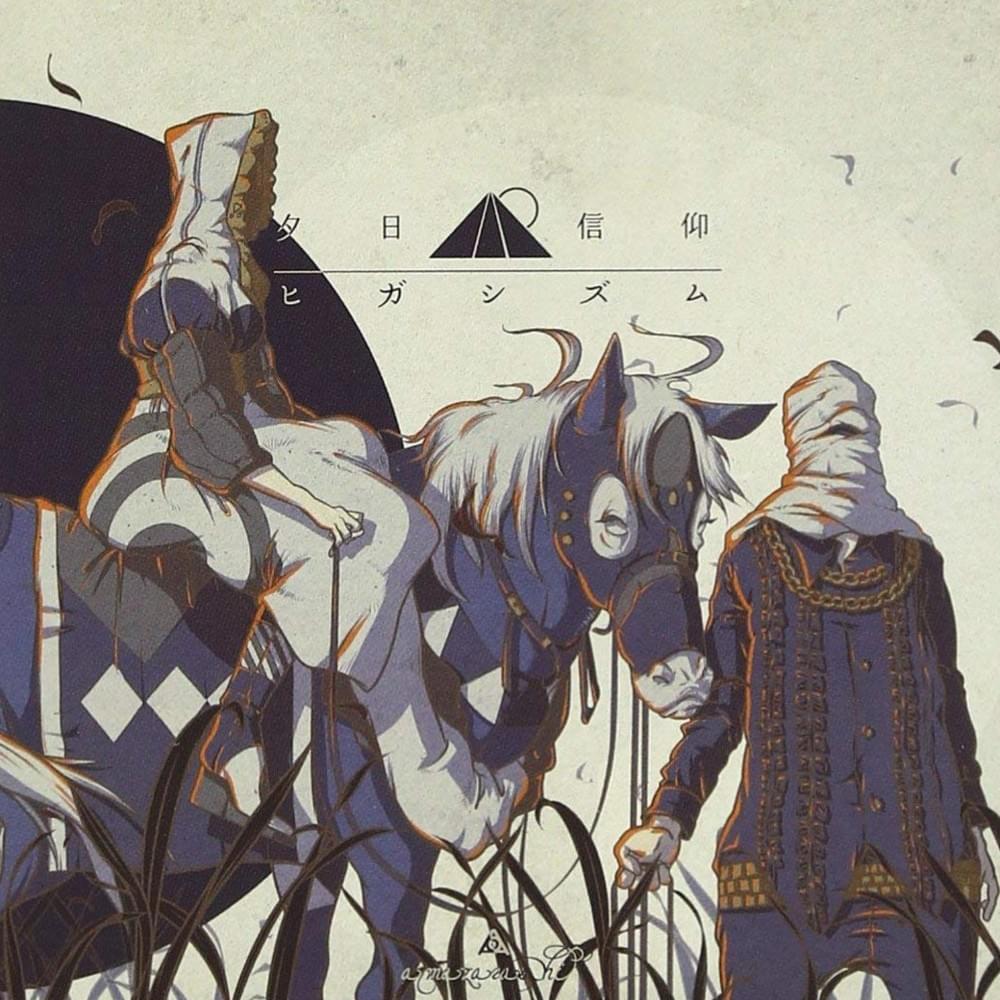
A striking recurring motif is the sunset, presented as a powerful, almost religious phenomenon. It's described as "beautiful" for "filling the emptiness" between the "stars and the distance between people," and later as a marker of "finite boundaries" and "strife." The repeated phrase "Humanism, Racism, the sun sets" links these grand ideologies with the inevitable, impartial descent of day. The sunset's red is multifaceted: the "red of the sunset," the "red of the place of death," the "red of lies," and the "red of blood," all serving as a "proof" for the narrator's "existence."
This relentless cycle of societal critique and existential affirmation is what gives the lyrics their potent emotional weight. The narrator grapples with the "human condition" – the "desire to judge, to cry, to die, to expose" – and ultimately chooses to "pick and choose" the reasons for their own existence. The final verses offer a fragile hope, acknowledging the "uncertainty" of tomorrow but still embracing the "promise" of meeting again, finding solace in the universal, impartial nature of the sunset, which becomes a symbol of "Higashism" – a faith in the transient, shared experience of endings and the affirmation of self in their wake.
 View Artist