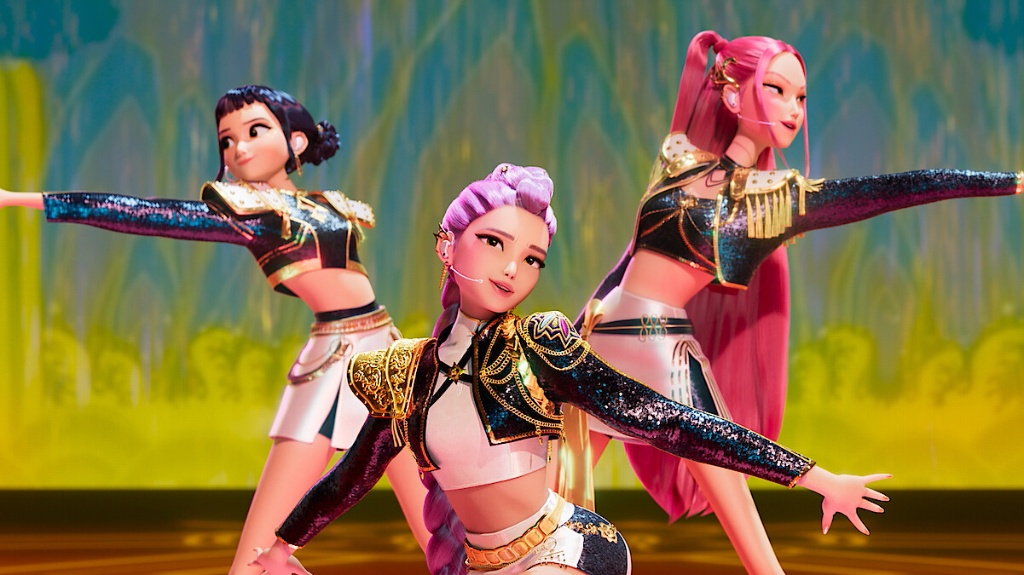
Three pop stars broke records all over the world. Too bad they only exist in a Netflix movie
Latest News

Senior Music Editorial Desk
They cannot go on concert tours, be photographed for interviews, or meet fans, simply because the band Huntr/x does not exist outside the screen. Nevertheless, Romy, Zoey, and Mira, the heroines of the animated film "K-Pop Demon Hunters," made history when they climbed to the top of the charts, bypassed real K-pop stars, and became a global sensation. Their soundtrack is not just a musical success, but a clear case study of how global pop culture blurs the lines between the fictitious and the tangible.
Almost a quarter of a century has passed since a girl group conquered the top of the Billboard Hot 100 chart. The last time was in the summer of 2001, when Destiny's Child (meaning, Beyoncé and the other two) reached number one with Bootylicious. Since then, big names like BLACKPINK, Fifth Harmony, Little Mix, and now also KATSEYE, have tried and failed to clinch the coveted summit. What none of the leading bands managed to grab, was achieved by three girls who don't actually exist.
Meet Romy, Zoey, and Mira, who make up Huntr/x, a carb-loving female K-pop group that also hunts soul-devouring demons and fights them through music. The members of the fictitious band are the stars of the Netflix animated film "K-Pop Demon Hunters." Since its release, the band has been breaking records with the hit Golden, which last week climbed to number one on the American Billboard Hot 100 chart (which weights radio play, streaming, and digital sales), and also took third place on the Billboard 200 (the best-selling albums chart). At the same time, "Demon Hunters" itself became the most-watched original animated film in Netflix history, and one of the company's top five original films.
This is a true sensation, and the world, or at least the narrow world of the K-pop genre, is reacting accordingly. True, animated films have launched hits into the charts before, such as The Lion King, Frozen, or Encanto, but the way the audience joyfully surrenders to the girls of Huntr/x and treats them as flesh-and-blood women is further proof of the growing blur between fake and reality. Huntr/x is indeed breaking records, and the musical talents behind the characters are completely real, but at the end of the day, this is a band that will not go on concert tours, will not be interviewed by the media, and will not attend fan meetings.
A Well-Managed Strategy
K-pop is much more than a genre of Korean pop music. It is an engineered cultural product that spreads as fast as a virus on steroids. It includes a visual language, choreographies timed with sacred anxiety, dramatic concepts, and a fan community that works full-time on spreading the message. K-pop fans don't just purchase albums; they translate interviews, manage campaigns to raise the artists' profiles online, and create music videos, dance tutorials, and memes. It is an organic marketing machine that can make even an animated film soundtrack become an international hit, if it is focused enough and commercialized smartly.
The creators of the "K-Pop Demon Hunters" soundtrack did everything right. The soundtrack was not built as a byproduct of the film, but as a product in its own right. The creators gathered a team from the best of K-pop’s sons and daughters, who worked on the album tracks for three years. It was led by super-producers like Teddy Park (who worked with BLACKPINK, among others) and Lindgren, who collaborated with Western creators like Stephen Kirk and Jenna Andrews (who also worked with BTS and TWICE), and together they all created a polished and sophisticated hybrid that would appeal to audiences around the world. A bit of shamanism and Korean mythology, a bit of Taylor Swift-style feminism, anime stylization, and a cross-border, cross-format message about "being true to yourself." The goal was to write songs that would work not only within the story but also outside of it, materials that can be played on the radio, put into playlists, and released as singles. It wasn't just a soundtrack; it was a well-managed penetration strategy.
The fact that K-pop culture already dances on the thin line between reality and fantasy, with bands assembled in musical laboratories, scripted characters, meticulous images, and interaction (not to mention an intense and deep relationship with the audience) that takes place almost entirely through screens, fit this strategy perfectly. In this sense, an all-animation girl group is an almost natural idea. Fans fall in love with the concept; they know the rules of the game in a world where aesthetics, myth, and story are no less important, and perhaps more so, than physical existence. In K-pop, fictitiousness is not a disadvantage; it’s a feature.
The project launch was accompanied by a digital campaign that looked as if it were born on TikTok: hashtags, tribute dances, official GIF sets, and fictitious profiles of the band members that made fans feel as if they and the three of them ate ramen from the same mess tin. The male and female fans are divided into veteran K-pop fans and young people who saw the movie, picked up the gauntlet, shared and spread it, and it didn't hurt to have the cooperation of real K-pop idols, who reacted to the movie and recreated scenes from it. The result: the songs soared in the charts of music streaming apps, including first place on Spotify US for the song by the fictitious and villainous boy band in the movie, Saja Boys, and first place, as mentioned, for Golden by Huntr/x, performed by EJAE (who also wrote the hit), Audrey Nuna, and REI AMI, the real voices behind the band.
Alongside the plays, which are counted in the hundreds of millions, there are also those who are quick to link the phenomenon to doomsday prophecies from the world of Artificial Intelligence, even though none of the stages of creating the album are related to AI. "Do you all realize that we are one step away from a total AI takeover of the music industry?" wrote a user yesterday (Tuesday) on the social network X (formerly Twitter). REI AMI, who sings the roles of the character Zoey, has already managed to get on her hind legs: "EJAE, Audrey Nuna, and I are not the product of AI! Are you guys stupid?". She is certainly not wrong, but there is no doubt that this situation sends confused users, looking for new idols to follow, into a completely new arena.
So how do you manage a career when there isn't even a real band? Trust the film's creators, Maggie Kang (this being her debut as a director) and Chris Appelhans (Wish Dragon), to make the most of the situation, along with their partner who does not shy away from financial success when she sees it, Netflix. So true, you can't sell tickets to a band that doesn't exist, but the success rests on the content alone anyway, and it will reign supreme. The music, the compelling story, and the animation, these allow the audience to connect to the idea of the band without demanding the traditional pound of interaction with flesh-and-blood artists. And there is even an advantage: Romy, Zoey, and Mira will forever remain 19 years old, perfect, with a steady voice and a breathtaking wardrobe, always appearing for battle against the right demon at the right time, and always available to sing the familiar hit at whatever volume you request.
About the Author
Senior Music Editorial Desk
LyricsWeb Editorial Team delivers trusted, research-backed coverage of music news, artist updates, and industry trends. As the Senior Music Editorial Desk, the team combines editorial expertise with cultural insight to publish accurate, timely, and reader-focused stories across genres.