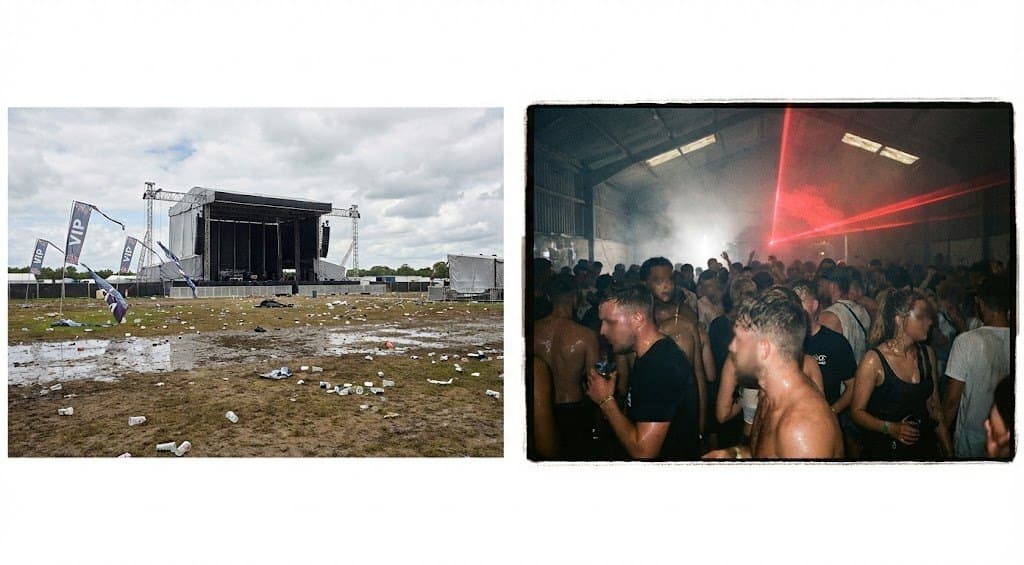
The VIP Wasteland: Why 2026 Is the Year the Mega-Festival Finally Died
Latest News
7 min read
Latest News

Jules "The Hawk" V.
Senior Music Editor
The silence is deafening. It’s April 2026, and for the first time in two decades, the Indio desert isn't vibrating. Ticket sales for the major global festivals are down 40% year-over-year. The "Influencer Olympics" have been cancelled due to lack of interest. What happened? How did the seemingly unstoppable juggernaut of the Mega-Festival—the rite of passage for every Millennial—hit a brick wall? The answer isn't just about inflation; it's about the soul of music itself.
The turning point: When Fred again.. proved that 500 sweating people in a room generate more energy than 50,000 on a field.
Let’s talk economics before we talk aesthetics. By 2025, the "Dynamic Pricing" model employed by monopolies had pushed the average festival weekend pass over the $800 mark. Add in travel, accommodation, and the infamous $18 canned water, and you were looking at a mortgage payment just to see Skrillex from a mile away on a giant screen.
For a generation grappling with a broken housing market and stagnant wages, the math stopped mathing. But it wasn't just the price tag. It was the value proposition. We realized we weren't paying for the music; we were paying for the privilege of standing in a VIP pen, separated from the actual energy of the crowd. The democratization of live music promised by Woodstock had morphed into a feudal system of wristband tiers.
A crowd is supposed to be a single organism—a holobiont. When Daft Punk played the pyramid in 2006, the crowd moved as one. By 2024, festival crowds had become thousands of individual broadcasters. The sea of phones didn't just block the view; it blocked the connection.
This is why 2026 has become the year of the "Micro-Rave." Across Brooklyn, Berlin, and East London, a new rule is being enforced with draconian strictness: No Phones on the Dancefloor. Stickers on cameras. Ejection for filming. The result? A sudden, violent return of the vibe. When you can't post about being there, you actually have to be there.
"Gatekeeping" used to be a dirty word. In 2026, it's a survival strategy. The new wave of promoters aren't advertising on billboards. They are using encrypted signal chats, discord servers, and physical flyers. You have to know someone to know where Fred again.. is doing his pop-up set tonight.
This exclusivity isn't about snobbery; it's about curation. It ensures that the people in the room are there for the bassline, not the brand activation. We traded the "Big Tent" inclusive philosophy for high-friction entry, and the music has never sounded better.
We still talk about the "Frank Ocean Incident" as a cautionary tale. When Frank Ocean dismantled the idea of a headliner set a few years ago, it felt like a betrayal. But in hindsight, he was just ahead of the curve. He understood that the Mega-Festival stage is a lie. It is too big for intimacy and too corporate for art.
Artists are now following suit. Tours are scaling down. Billie Eilish is playing residencies in mid-sized theaters rather than stadiums. The industry is realizing that 5,000 die-hard fans screaming every word is worth more than 100,000 casuals waiting for the drop.
So, where does that leave the giants? The Coachellas and Lollapaloozas of the world are now scrambling to pivot, creating "boutique" experiences to lure us back. But the trust is broken. The culture has moved back underground, where it belongs.
In 2026, luxury isn't a VIP cabana. Luxury is a dark room, a heavy sound system, a $20 cover charge, and the person next to you dancing like nobody is watching—because for the first time in ten years, nobody is recording.
0/5.0 - 0 Ratings
Loading comments...