The Luxury of Error: Why 'Voice Cracks' Are the New High Note in 2026
Latest News

Lead Music Critic & Industry Observer
Perfection has become cheap. In February 2026, anyone with a monthly subscription to a generative AI model can create a symphony that is technically flawless. You can generate a vocalist who never misses a note, a drummer who never drags the tempo, and a mix that is mathematically balanced across the frequency spectrum. And yet, if you look at the Billboard charts this week, the sound is shockingly unpolished. We are witnessing the rise of the "Flaw Economy"—a cultural moment where the most valuable commodity in music is a mistake.
The trend is audible in the production choices of the year’s biggest hits. The lush, cavernous reverb that dominated the pop landscape of the 2010s and early 2020s has all but evaporated. In its place is the "Dry Mix." Producers are placing vocals aggressively close to the listener's ear, stripping away the effects that used to hide imperfections. When Gracie Abrams sings on her latest record, you can hear her sharp intake of breath. You can hear the mechanics of her mouth moving. It is intimate to the point of discomfort, and that is exactly the point.

The Rebellion Against "The Machine"
This seismic shift is a direct, subconscious reaction to the proliferation of AI in creative spaces. As machines get better at mimicking human creativity, humans are doubling down on the one thing machines cannot authentically replicate: vulnerability. A computer can simulate a voice crack, but it cannot feel the anxiety that causes one. It cannot replicate the adrenaline of a live mistake.
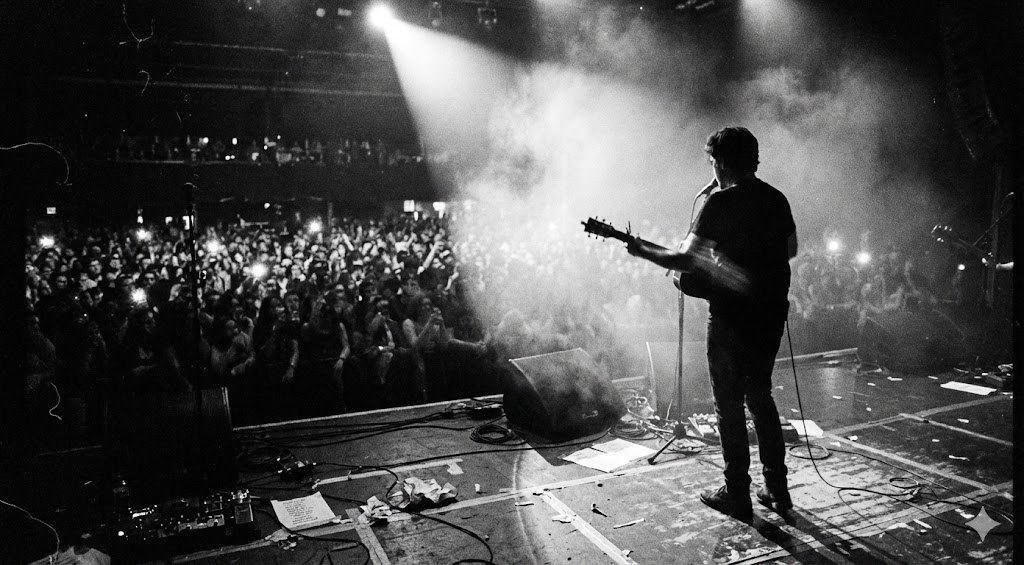
Take the massive, stadium-filling success of Noah Kahan. His song Stick Season, featured in the live performance above, is the anthem of this movement. It’s a track driven by frantic strumming, shouted choruses, and lyrics that tumble out with little regard for poetic meter. When performed live at Fenway Park, Kahan doesn't try to sound like the record. He sounds tired. He sounds overwhelmed. And 40,000 people scream every word back at him because that exhaustion feels real.
The "Stomp and Holler" Renaissance
This hunger for the organic has fueled the "Stomp and Holler" renaissance, a revival of folk-adjacent aesthetics led by Kahan, Zach Bryan, and Hozier. These are artists whose music relies on wood, wire, and lung capacity. There is no grid to hide behind. Unlike the "Metaverse Concerts" we were promised would take over the industry, these shows are aggressively analog.
The appeal lies in the communal recognition of pain. In 2026, we don't go to concerts to see a spectacle; we go to attend a secular mass. We want to see the sweat on the artist's brow. We want to hear the guitar string buzz against the fretboard. These "flaws" act as a verification badge for reality.
The Psychology of the "Dry Mix"
From an audio engineering perspective, the "Dry Mix" creates a psychological effect known as "Parasocial Proximity." By removing the reverb (which simulates a large space), the brain is tricked into thinking the singer is standing right next to you. This is why the vocals of Olivia Rodrigo in her recent rock-ballads feel so confrontational. She isn't singing from a stage; she's singing from inside your head.
This technique stands in stark contrast to the "Wall of Sound" production of previous decades. It requires a tremendous amount of confidence from the artist, as every vocal tic and pitch wobble is exposed. But in the "Flaw Economy," these wobbles are not edited out—they are turned up.
The Economics of Intimacy
There is, of course, a financial angle. The "Unplugged" aesthetic lowers the overhead for touring but raises the emotional value of the ticket. Fans are increasingly complaining about "Over-Produced" shows where the backing track does the heavy lifting. A specific critique has emerged on TikTok in 2026: "Did they even sing?"
To counter this, artists are stripping back. The "Acoustic Set" in the middle of a pop show has gone from a nice interlude to the main event. It is the moment smartphones go up—not to capture the lasers, but to capture the silence.
The End of Auto-Tune as a Safety Net
Auto-Tune isn't dead, but its function has changed. It is no longer a corrective tool used to fix bad singing; it is an aesthetic choice, like a distortion pedal, used for specific effect (think Travis Scott or Bon Iver). But for the emotional ballads that define the charts of early 2026, pitch correction is being dialed down to zero. We are learning to love the flat notes. We are learning to appreciate the strain.
As we move deeper into this year, listen closely to the production choices. Notice how dry the snare drums sound. Notice how loud the breathing is. The music industry has realized that in a synthetic, AI-generated world, the most radical thing you can be is a messy, imperfect human.
About the Author