The Heavy, Necessary Weight of J. Cole’s The Fall-Off
Latest News
Senior Music Journalist
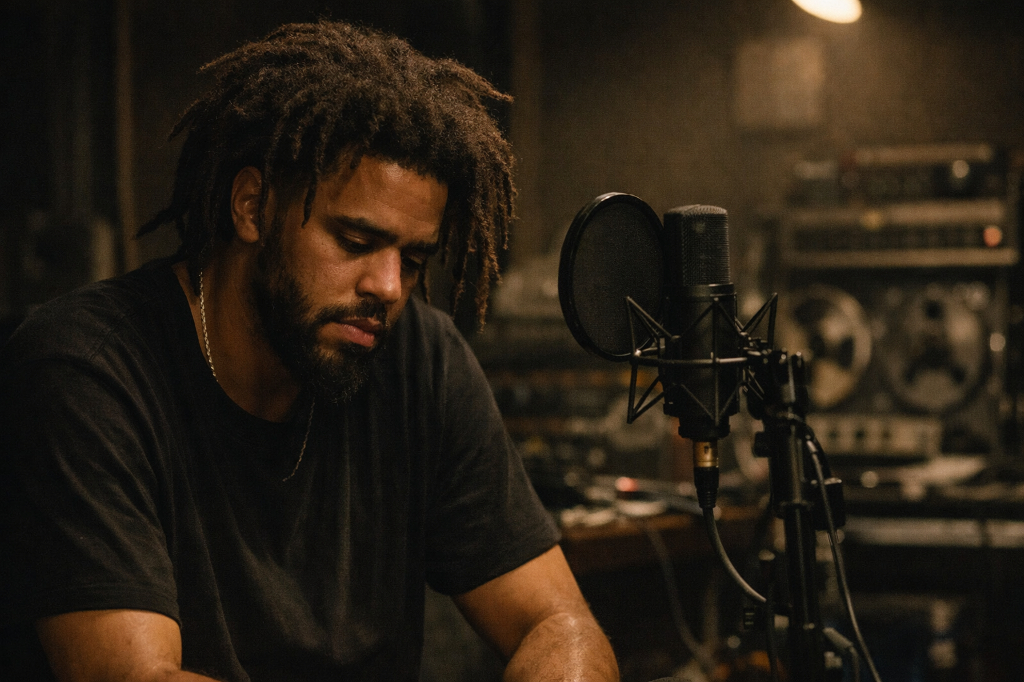
The first thing that hits you about The Fall-Off isn't a sweeping cinematic swell or a grandiloquent introduction, but rather the sound of a man breathing in a very specific, pressurized room. It is the audio equivalent of a veteran pitcher tightening his laces before the ninth inning. For years, J. Cole has teased this moment as a terminal point, a final competitive gasp before stepping away from the microphone for good. On the opening track, the production feels skeletal, almost brittle, as if the music itself is afraid to distract from the technical precision of the vocal. It’s a creative decision that rejects the bloat of the streaming era, opting instead for a claustrophobic intensity that demands you acknowledge every syllable.
There is a specific kind of tension that exists when an artist of J. Cole’s stature decides to lean entirely into his strengths rather than experimenting with the avant-garde. We saw flashes of this on The Off-Season, but where that record felt like a high-intensity scrimmage, The Fall-Off carries the gravity of a championship game. The textures here are dusty and grounded, rooted in a Southern rap tradition that favors the soul loop and the crisp snare over the distorted 808s that have dominated the charts recently. It is a record that feels like it was made in a basement but polished in a cathedral, providing a stark contrast to the polished, often hollow aesthetics of his contemporaries.
The production on tracks like "Crooked Smile" or "Middle Child" previously sought a middle ground between radio accessibility and backpacker ethos, but The Fall-Off abandons the pursuit of the "hit" entirely. Instead, we get compositions that shift underfoot. One particular mid-album cut starts with a languid jazz piano before collapsing into a frantic, double-time breakbeat that forces J. Cole to pivot his flow mid-sentence. It’s a flex of pure athleticism. He isn't just rapping; he’s navigating a shifting landscape, proving that his internal metronome is more reliable than any digital click track. This focus on the "craft" over the "vibe" is what separates this project from the mood-heavy releases we’ve seen from the likes of Drake or the experimental detours of Kendrick Lamar.
When looking at his discography, 2014 Forest Hills Drive remains the sentimental favorite, the moment he captured the zeitgeist by going "platinum with no features." However, that album relied heavily on a youthful idealism that has since been tempered by the realities of aging in a genre that often treats its elders as relics. On The Fall-Off, the idealism is gone, replaced by a weary but sharp-eyed pragmatism. He speaks on the industry not as a participant looking for validation, but as a landlord observing the property value. The cultural placement of this album is fascinating; it arrives at a time when the "Big Three" conversation has been revitalized and subsequently charred by public conflict. Cole’s response is to retreat into the booth and out-rap everyone until the argument feels redundant.
The middle section of the record features a three-track run that serves as a masterclass in narrative structure. He moves from the micro—a story about a neighborhood kid lost to the system—to the macro, examining the spiritual cost of wealth. The transition between these songs is seamless, handled through subtle foley work and ambient noise that makes the album feel like a continuous thought rather than a collection of MP3s. It’s here that the technical prowess becomes most apparent. He’s playing with internal rhyme schemes that would make a linguist sweat, yet he delivers them with the conversational ease of a man telling a story over a game of dominos. There is no strain in his voice, even when the subject matter is heavy, which only adds to the sense of total control.
However, the album isn't without its points of friction. There are moments where the insistence on being "the best" feels like it borders on an obsession that prevents the music from breathing. A couple of tracks in the latter half lean perhaps too heavily on the "rap about rapping" trope that has occasionally dogged Cole’s career. When he’s dissecting his own legacy, he’s magnetic; when he’s complaining about the younger generation’s lack of discipline, it can feel a bit like a lecture we've heard before. Yet, even these moments are saved by the sheer quality of the writing. He’s so much better at the "grumpy old man" routine than most because he backs it up with a level of verbal dexterity that most of the "new school" hasn't even attempted to learn.
Culturally, The Fall-Off acts as a bridge. For the 18–35 demographic, it is a reminder of what rap can be when it is treated as a high-stakes competitive sport. For the 35–55+ audience, it is a comforting signal that the foundational elements of the genre—lyricism, storytelling, and rhythmic complexity—are still being championed at the highest level. It doesn't feel like a nostalgia trip, though. The production is too sharp, the perspective too current. He isn't living in the past; he’s just using the tools of the past to build something that feels remarkably sturdy in a very flimsy era. The record is a monolith, something that demands to be sat with and unpacked over multiple listens rather than consumed and discarded in a single afternoon.
As the final notes of the closing track fade out—a haunting, stripped-back arrangement that leaves his voice hanging in the air—the feeling isn't one of sadness, but of completion. If this truly is the end of the road for J. Cole, he hasn't just exited the stage; he’s dismantled the podium and taken the microphone with him. The Fall-Off is a dense, sometimes difficult, but ultimately rewarding piece of work that prioritizes the artist's own standards over the market's demands. It is a rare thing in the modern landscape: an album that feels like it was written in ink, not in pencil. It doesn't matter where it lands on the charts—though it will likely land at the top—what matters is the conviction behind it. Cole didn't just show up for the fight; he made sure he was the only one left in the ring.
About the Author