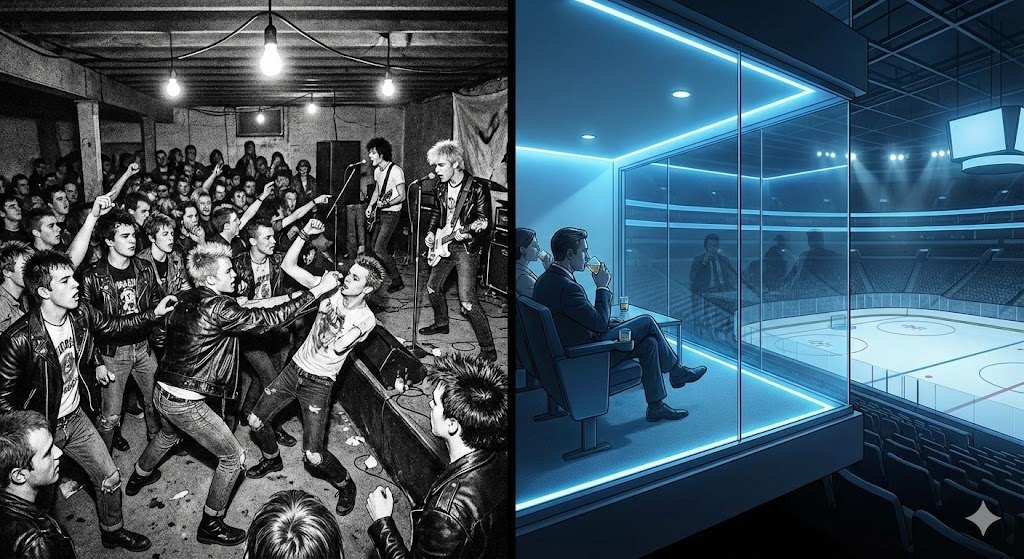
The Gentrification of the Mosh Pit: When Live Music Became a Luxury Good
Latest News

Senior Editorial Board
It is 9:58 AM on a Tuesday, and Sarah, a 23-year-old barista from Austin, Texas, is sweating. She has three laptops open, a credit card with a precarious balance, and a "Verified Fan" code that feels less like a golden ticket and more like a lottery number for a lifeboat. She isn’t trying to buy a house or a car. She is trying to buy two nosebleed seats to see Olivia Rodrigo.
By 10:04 AM, the queue has paused. By 10:07 AM, the "dynamic pricing" algorithm kicks in. The tickets that were advertised at $149 are now $480 each, plus fees. Sarah closes her laptop. The show isn't sold out, but for her, the doors are locked. She has been priced out of her own culture.
Welcome to the Live Music Class War of 2026.
The "Platinum" Wall
For decades, live music was the great equalizer in American culture. Whether you were a hedge fund manager or a line cook, if you loved The Cure, you stood in the same sweaty stadium, sang the same lyrics, and experienced the same catharsis. The floor section wasn't a VIP enclosure; it was a meritocracy of passion. If you wanted the rail, you didn't pay extra; you slept on the sidewalk.
That era is effectively dead. According to a grim Q4 2025 report by Pollstar, the average ticket price for a top-100 tour in North America has risen 48% since 2023, vastly outpacing inflation. But the average tells a polite lie. The real story is in the variance.
With the universal adoption of algorithmic pricing—a system borrowed from airlines and Uber—ticket prices now react to demand in real-time. This has created a "Platinum Wall," where the first 20 rows of any arena show are exclusively populated by those with high disposable income, not necessarily high fandom.
"The energy in the front row has changed. I look down and I don't see the kids who know every deep cut. I see people checking their emails who bought the tickets because they were the most expensive ones available." – Anonymous Tour Manager (Arena Level Rock Act)
The Artist's Complicity
It is easy to point the finger at the monopolies—and we should—but the silence from the stage is deafening. For years, artists claimed ignorance regarding pricing models. In 2026, that excuse no longer holds water. Artists have the power to turn off dynamic pricing. Zach Bryan proved it. The Cure proved it. If an artist's tickets are selling for $1,200, it is because the artist (or their management) allowed the algorithm to run wild.
However, the economics of touring have also become brutal. The cost of fuel, trucking, insurance, and venue rental has skyrocketed. For mid-tier artists, the profit margins are razor-thin. They are faced with a moral dilemma: Price the tickets fairly and risk bankruptcy, or let the algorithm rip and alienate the fanbase that built them.
This has led to a bifurcation of the industry. We are seeing fewer "middle class" touring acts. You are either a stadium giant charging $500 a seat, or you are a van-tour act playing for $20 covers. The middle ground—the theater tour, the 3,000-cap hall—is vanishing because the economics simply don't math out for the consumer.
The Gen Z Counter-Movement: "Gatekeeping" as Protection
If there is a silver lining, it is coming from the underground. Pushed out of the arenas, Gen Z is revitalizing the DIY scene with a ferocity we haven't seen since the hardcore punk movement of the 1980s.
In Brooklyn, Los Angeles, and Chicago, a network of warehouse shows and secret raves is thriving. The ticket prices are fixed ($25-$40), the locations are dropped via text message, and strictly no "dynamic" nonsense is allowed. Bands like Fontaines D.C. have leaned into this, playing smaller, grittier venues despite being able to sell out much larger rooms.
Interestingly, this has led to a rise in "Gatekeeping" as a positive term among younger fans. To "gatekeep" a band or a venue is no longer seen as elitist; it is seen as a protective measure to keep the "finance bros" and the scalpers out of the ecosystem. If the mainstream industry wants to treat music like a luxury commodity, the youth are responding by taking the music off the market entirely.
The Silence of the Arenas
There is a breaking point, and we may have hit it last summer. The "Soft Ticket Crash" of 2025 saw several major arena tours canceled due to low sales. The public simply refused to pay. It was a wake-up call that the elasticity of demand is not infinite.
When Taylor Swift ends her monumental run, who replaces her? By pricing out the 18-year-olds today, the industry is failing to build the nostalgia of tomorrow. A fan who can't afford to see their favorite band in 2026 is a fan who won't be buying the reissue vinyl in 2036.
Music is not a Birkin bag. It is a utility. It is a social service. When you restrict access to it based on tax brackets, you don't just lose revenue; you lose the culture. As we look at the slate of tours for Summer 2026, the question isn't "Who is playing?" The question is: "Who is this actually for?"
If the answer continues to be "the highest bidder," the silence in the desert won't be from a phone ban—it will be from an empty crowd.
About the Author
Senior Editorial Board
LyricsWeb Editorial Team delivers trusted, research-backed coverage of music news, artist updates, and industry trends. As the Senior Music Editorial Desk, the team combines editorial expertise with cultural insight to publish accurate, timely, and reader-focused stories across genres.