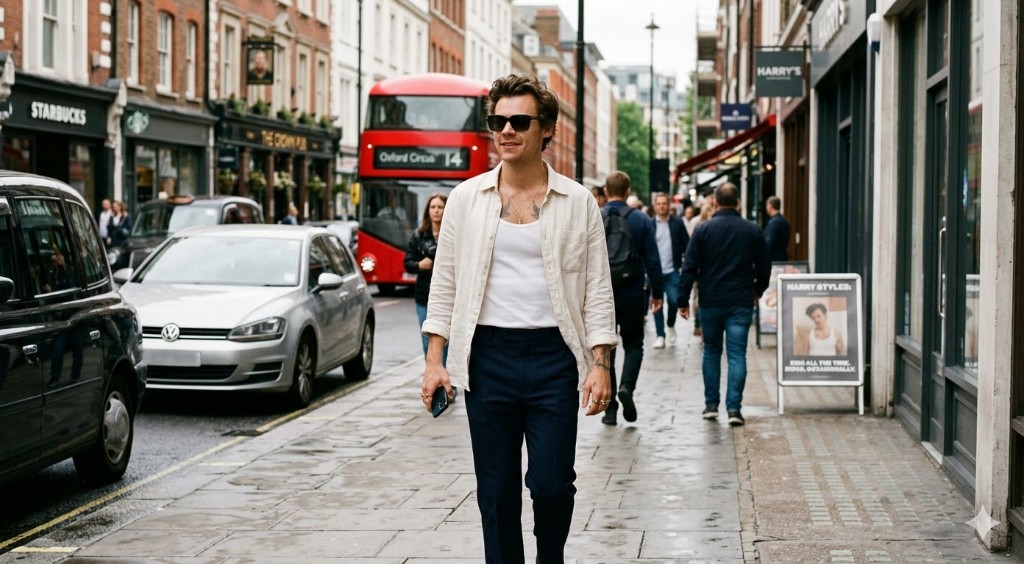
Harry Styles’ “Kiss All The Time. Disco, Occasionally.” Turns Inward Without Losing Its Pop Scale
Latest News

Music Journalist
Harry Styles has never had a problem selling a mood. What changes on Kiss All The Time. Disco, Occasionally. is the kind of mood he wants to sell. This is not built like a bright, instantly memed pop blockbuster chasing the same center of the room that Harry’s House often occupied. Instead, Harry narrows the lighting, lowers the temperature, and lets this record move like a late-night conversation that starts flirtatious and ends somewhere far more revealing. The album still has glamour. It still has hooks. But it is more interested in tension than release, in atmosphere than applause, and in emotional restlessness than easy reassurance.

That shift becomes obvious almost immediately. “Aperture” opened the era with a sense of movement rather than impact, and “American Girls” deepens that approach by sounding bigger, slicker, and sadder than its title first suggests. The production across the album leans into synth lines, club pulse, and elegant repetition. Harry does not rush to overcrowd these songs. He lets them breathe. He gives rhythm room to do narrative work.
That matters because one of the smartest things about this album is that it refuses to confuse polish with emptiness. On first listen, the surfaces can feel luxurious and controlled. On a closer listen, there is loneliness all over this record. It appears in the pauses, in the detached phrasing, and in the way several songs circle desire without pretending desire automatically resolves into intimacy. Harry sounds less interested in performing charm for its own sake and more interested in documenting what happens after the party glow fades.
This is why “American Girls” lands so effectively. It works as pop music because it is stylish and highly replayable, but it also works because it carries a faint ache underneath the motion. That tension gives the song a second life beyond first-week streaming numbers. It does not just sound good. It leaves residue. The same is true for “Ready, Steady, Go!”, which pushes outward with sharper momentum, and “Are You Listening Yet?”, which feels almost confrontational in the way it asks for attention without begging for it.
Elsewhere, the album gets stronger when it slows its pulse just enough to let Harry’s writing come into focus. “Taste Back” and “The Waiting Game” are the kind of songs that reveal how much more comfortable he has become with understatement. He no longer needs every line to announce itself as a statement. He trusts texture, sequencing, and emotional implication. For a major pop artist operating at this scale, that restraint is not a small creative choice. It is part of what gives the record its identity.
The middle of Kiss All The Time. Disco, Occasionally. is especially good at turning repetition into character. “Season 2 Weight Loss” and “Coming Up Roses” keep the record from becoming too sleek for its own good. They introduce friction. They make the album feel lived in rather than merely designed. Even “Pop”, a title that could have invited something obvious, plays with self-awareness instead of settling for self-congratulation.
A lot of mainstream albums announce maturity by draining out pleasure. Harry does the opposite here. He lets pleasure stay in the room, but he complicates it. “Dance No More” and “Paint By Numbers” are built like songs that understand how repetitive nightlife can become when you are still searching for something steadier underneath it. He is not rejecting the spectacle that made him one of pop’s most bankable artists. He is rewriting what that spectacle is allowed to contain.
That is ultimately what makes this album worth covering aggressively on LyricsWeb. It offers more than release-week scale. It offers songs that can keep generating conversation, lyric interpretation, and repeat engagement. “Carla’s Song” closes the set in a way that feels deliberate rather than decorative, and it reinforces the broader point of the record: Harry is no longer trying to make pop that simply wins the moment. He is trying to make pop that lingers after the moment has already passed.
For readers moving deeper into the project, the strongest next click is obvious: explore the full album page, then move track by track through “Aperture”, “American Girls”, “Taste Back”, and “The Waiting Game.” This era is built for internal depth, and that is exactly where LyricsWeb should own the user journey
About the Author
Music Journalist
Nia Harris writes about the intersection of music, identity, and cultural movements for LyricsWeb.