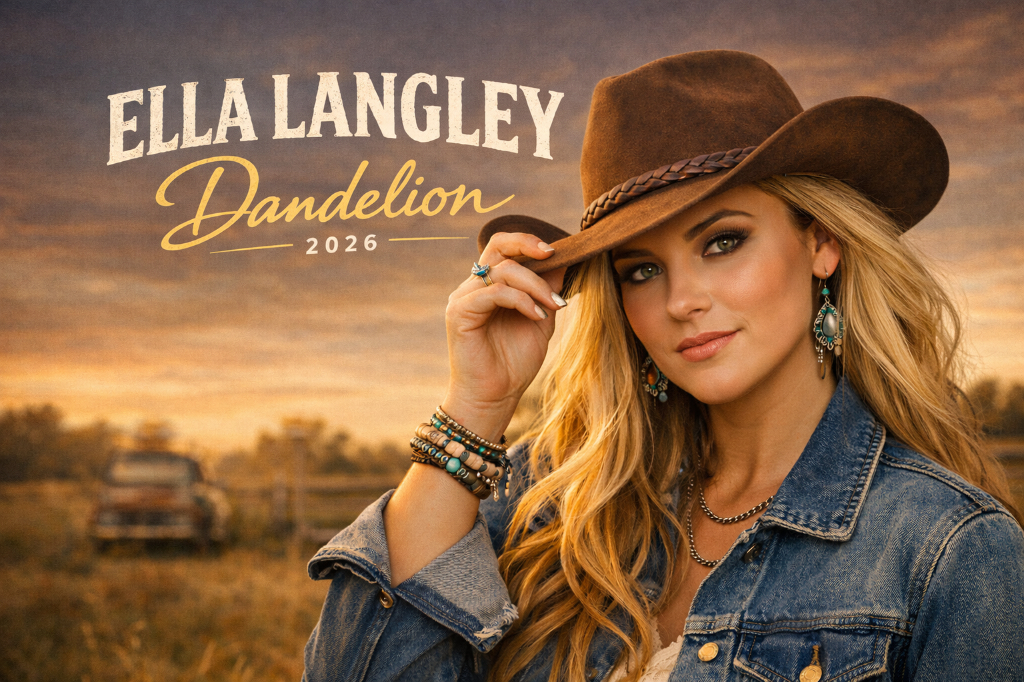
Ella Langley’s Dandelion Turns a Breakout Run Into a Real Country Statement
Latest News

Music Journalist
Ella Langley did not arrive at Dandelion by accident. By the time the album officially landed on April 10, 2026, she had already spent months building a case that she was no longer just one of country music’s most promising young names. She was becoming one of its most reliable hitmakers, and more importantly, one of its most recognizable voices. Dandelion feels like the record where the buzz finally hardens into identity. It doesn’t sound like a desperate swing for crossover validation. It sounds like an artist who knows exactly what kind of country album she wants to make, and knows the audience is finally ready to meet her there.

That matters, because Dandelion is not one of those albums that appears out of nowhere and asks listeners to do all the work on release day. Several of its biggest songs were already out in the world long before the full tracklist hit streaming services. “Choosin’ Texas” dropped back on October 17, 2025. “Dandelion”, the title track, followed on January 30, 2026. “Be Her” arrived on February 13, 2026. So the album release is new, but the emotional architecture has been under construction for a while. That rollout gives the record an unusual advantage: when you hit play, it already feels lived-in.
The first thing that stands out is how little this album chases the wrong things. A lot of contemporary country records are built like playlists, with one eye on Nashville, one eye on pop streaming, and a third imaginary eye on TikTok clips. Dandelion is sharper than that. It is commercial, sure, but it doesn’t feel engineered in a lab. The production is polished without sanding off the grain. The writing is direct without getting lazy. The emotional beats are familiar, but they hit because Langley knows how to sell a line without oversinging it or drowning it in spectacle.
“Choosin’ Texas” still sounds like the breakthrough centerpiece. It is one of those songs that works because it understands the bones of country music: place, pride, memory, heartbreak, and the ugly realization that love is not always strong enough to beat where somebody comes from. The writing is clean, but it is not simple-minded. The hook lands because it feels inevitable. By the time Langley sings about a cowboy always finding a way to leave, the track has already told you the ending. The brilliance is that she still makes it sting. That song gave her a massive commercial moment, but it also gave this album a center of gravity.
If “Choosin’ Texas” is the record’s outward-facing hit, then “Be Her” is one of its most revealing interior songs. It takes a concept that could have easily turned vague or preachy and makes it painfully specific. This is not some generic empowerment anthem. It is a song about envy, self-measurement, and the fantasy of becoming the kind of woman who seems untouched by chaos. That is a very American country move, really—turning an idealized character into a mirror, then letting the listener decide whether the song is about admiration, insecurity, or both. The result is one of the album’s strongest emotional pivots.
The title track, “Dandelion”, explains the album better than any press quote could. Langley frames herself as the kind of woman who was never meant for a crystal vase. She belongs in a mason jar, in old blue jeans, in the rougher parts of the frame. That image could have come off like branding if the song were weaker. Instead, it lands because the lyrics are rooted in lived texture: dirt roads, whiskey over champagne, faith as inheritance, Southern identity as bloodstream rather than costume. It’s a smart title song because it functions as both mission statement and self-portrait.
One reason the record hangs together so well is the consistency in the creative circle around it. Langley works with producers and writers who understand how to give her enough room without flattening the material into one speed. The repeated presence of Miranda Lambert is especially meaningful. She does not just bring name value. She brings context. Her involvement quietly places Langley inside a line of artists who care about strong hooks, sure, but care just as much about point of view. You can hear that in the balance of the album: the swagger never gets cartoonish, the sad songs never turn syrupy, and the rootsy details never feel fake.
That balance is what gives songs like “Speaking Terms” their weight. This is one of the album’s more vulnerable turns, and it goes somewhere many modern country projects avoid. Instead of making faith a decorative detail, Langley treats it like an unsettled relationship. The song is built around silence, doubt, patience, and the ache of wondering whether anyone is on the other side of the conversation. It is not a grand theological statement. It is a personal one. That makes it stronger. The track adds dimension to the album because it proves Langley is not only good at writing about romantic fallout or identity pride; she can also write about spiritual distance in a way that feels intimate and unforced.
Elsewhere, the album keeps circling back to the same core tension: how do you stay true to yourself when success keeps trying to clean you up for mass consumption? That is where Dandelion earns its keep. It does not present Langley as flawless, healed, or fully figured out. It presents her as someone stubborn enough to remain recognizable. In today’s market, that can be more compelling than reinvention. Reinvention is easy to market. Identity is harder. Identity demands repetition, conviction, and enough trust in your own voice to let the songs speak without apologizing for their accent, their references, or their pace.
There is also a broader industry angle here. Country music in 2026 is in one of those periods where the genre is commercially huge and aesthetically split. Some artists are leaning farther into pop, some are digging back into old-school country textures, and some are trying to blur the line so aggressively that they stop sounding like themselves. Langley’s lane is clearer than that. She pulls from traditional country, but she does not cosplay tradition. She understands radio, but she does not flatten her storytelling to please it. That gives Dandelion a strong shot at lasting beyond its release-week headlines.
For LyricsWeb, this is exactly the kind of release that makes sense as a main story. It has the chart angle, the release-day urgency, the recognizable singles, and the kind of lyrical depth that gets people clicking through song pages instead of stopping at a quick headline. Someone who comes in for “Choosin’ Texas” can end up staying for “Be Her”. Someone who knows the title track can discover “Speaking Terms”. That is how a release like this moves from music news into real user behavior.
And that may be the clearest sign that Ella Langley has crossed into a different tier. Dandelion is not just a collection of songs released around a hot streak. It feels organized, intentional, and personal in a way that a lot of supposedly major albums never do. The singles were strong enough to open the door. The full project is strong enough to make that door harder to close.
About the Author
Music Journalist
Ashley Tan brings energetic, backstage-level coverage of live music and emerging artists to LyricsWeb readers.