NEON BOYS
Artist Bio
Introduction & Current Status
The name NEON BOYS might not be splashed across today's streaming charts, but their legacy? That's still hitting different. This legendary outfit, a blink-and-you-miss-it phenomenon from the raw, gritty streets of 1970s New York City, remains a foundational pillar for anyone tracing the lineage of punk rock. They were the original spark before the full-blown inferno of CBGB's golden age.
Think of them as the ultimate deep cut, the band your favorite band's favorite band probably obsessed over. While their official discography is lean, their impact is anything but. They didn't just play music; they helped forge a new sound, a new attitude, and a new blueprint for what rock and roll could be. Their few tracks are essential listening, a masterclass in minimalist rebellion.
Even today, discerning music heads and cultural historians recognize the NEON BOYS' pivotal role. They weren't just a band; they were a moment, a crucial evolutionary step that birthed giants like Television and Richard Hell and the Voidoids. Their influence echoes in every snarling guitar riff and poetic lyric of subsequent punk and post-punk waves, proving that sometimes, the shortest stories leave the longest shadows.
Early Life & Background
Before the NEON BOYS flickered into existence, two young poets and musicians, Tom Miller (soon to be Verlaine) and Richard Meyers (soon to be Hell), found their creative orbits colliding in the vibrant, anarchic energy of early 1970s New York. Both hailed from Delaware, sharing a restless spirit and an aversion to the rock clichés of the era. They were less interested in stadium rock excess and more captivated by Beat poetry, avant-garde art, and the raw power of Velvet Underground.
Their shared vision was simple yet radical: strip rock music back to its skeletal core. They craved something immediate, intellectual, and visceral, a stark contrast to the bloated progressive rock and saccharine pop dominating the airwaves. This wasn't just about forming a band; it was about articulating a burgeoning cultural dissatisfaction, a craving for authenticity in a world of manufactured sheen.
Their early days were spent soaking in the downtown scene, absorbing influences from jazz to experimental noise, all while honing a unique lyrical sensibility that blended street-level grit with a literary edge. This fertile ground of shared influences and a mutual desire for musical revolution laid the perfect foundation for the raw, unpolished brilliance that would define the NEON BOYS' brief, but impactful, existence.
Career Beginnings
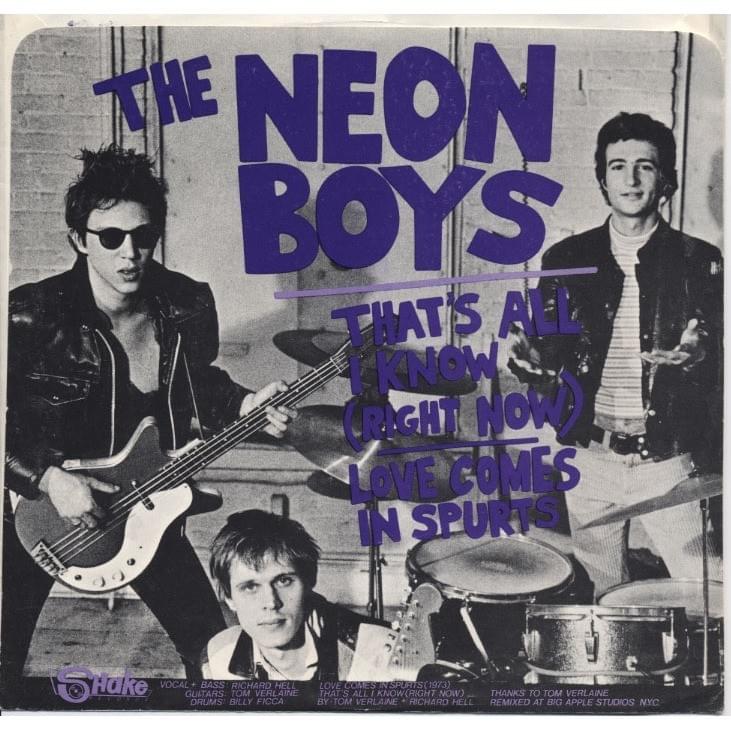
Formed in 1973, the NEON BOYS were Richard Hell on bass and vocals, Tom Verlaine on guitar, and Billy Ficca on drums. Their formation was less a grand plan and more an organic convergence of kindred spirits ready to shake things up. They bypassed the polished studio sounds of the day, opting for a stripped-down, aggressive approach that felt both primitive and futuristic.
Their sound was a direct reaction against the prevailing rock norms, a deliberate embrace of jagged edges and raw energy. They rehearsed tirelessly, crafting a tight, urgent sound that was equal parts intellectual punk poetry and garage rock ferocity. The band quickly garnered a reputation in the nascent downtown scene for their incendiary live performances and minimalist aesthetic.
The NEON BOYS’ breakthrough moment, if you can call it that for a band so short-lived, was less about chart success and more about critical mass within their small, influential circle. They recorded a handful of tracks in 1973-74, laying down the blueprint for what would become punk rock's defining sound. These recordings, though unreleased for years, quickly became legendary among those in the know, thanks to the sheer, unadulterated power of tracks like Thats All I Know (Right Now) and the iconic Love Comes In Spurts. Their brief existence was a crucial incubator, setting the stage for bigger things to come.
Major Albums & Discography
While the NEON BOYS' active period was fleeting, their recorded output, though limited, is monumental in its historical significance. They never officially released a full-length album during their tenure, but their 1973-74 recordings became the stuff of legend, eventually seeing the light of day decades later. This posthumous release, often referred to simply as The Neon Boys, is a holy grail for proto-punk aficionados.
The compilation, featuring those early, raw sessions, showcases the band's unbridled energy and innovative sound. Critics, looking back, have lauded it as a cornerstone of the punk movement, a raw snapshot of a scene on the cusp of explosion. It wasn't about commercial performance then, but about laying down the sonic law for a generation of rebels.
The album, or rather, the collection of tracks like Thats All I Know (Right Now), captured their evolution from abstract artistic ideas into concrete, visceral rock and roll. It perfectly encapsulates their raw, minimalist approach, proving that you don't need elaborate production to make a profound statement. It's a testament to their vision that these recordings still sound vital and urgent today, often cited as a direct lineage to punk's initial blast.
This limited discography, including the seminal The Neon Boys collection, cemented their place in rock history. It's not about quantity but impact. Each track is a masterclass in conciseness, a perfect distillation of the anxiety and excitement that defined early 70s downtown New York. For fans of authentic, no-frills rock, this collection is an absolute must-listen.
Hit Songs & Signature Tracks
While the concept of "hit songs" in the traditional sense didn't quite apply to the NEON BOYS' era of underground legend, their handful of recorded tracks achieved a different kind of immortality. These were the proto-punk anthems that sparked a movement, tracks that, despite never hitting the Billboard charts, became signature statements for an entire generation of artists and fans. They're low-key iconic for their sheer, raw power.
Take Love Comes In Spurts, for instance. This track is pure, unadulterated energy, a frantic, poetic explosion that perfectly embodies Richard Hell's confrontational, yet intellectual, aesthetic. Its urgent rhythm and snarling vocals are often credited with defining the very sound of early punk, inspiring countless bands to pick up instruments and scream their truths.
Then there's Thats All I Know (Right Now), a track that showcases the NEON BOYS' ability to blend melodic tension with raw aggression. It's a compelling example of their stripped-down genius, proving that profound emotional impact doesn't require elaborate arrangements. This song, like many of their brief recordings, laid the groundwork for the future of punk lyrics – direct, honest, and utterly without pretense.
And let's not forget the undeniable swagger of High Heeled Wheels. This track oozes cool, a perfect fusion of Tom Verlaine's distinctive guitar work and the band's overall minimalist punch. These songs, while few, were more than just tunes; they were manifestos, cultural touchstones that helped shape the sound and ethos of one of music's most revolutionary genres. They're the kind of tracks that instantly give you main character energy.
Collaborations & Features
The NEON BOYS, in their original incarnation, were a tightly knit unit, more focused on forging their distinct identity than on external collaborations. Their short existence meant fewer opportunities for features or cross-genre work. However, their story is inherently a tale of collaboration, specifically the intense creative dynamic between Richard Hell and Tom Verlaine, which was the very crucible of the band.
This internal collaboration was the engine that drove their sound, blending Hell's confrontational poeticism with Verlaine's angular, innovative guitar work. The band itself was a collaborative experiment in stripping rock to its essence. Their collective efforts created a sound so groundbreaking it would reverberate for decades, directly informing the punk movement that followed.
While the NEON BOYS didn't feature other artists, their existence was a direct precursor to some of the most influential collaborations in punk history. The band soon evolved into Television, with Hell and Verlaine continuing their creative partnership for a time, before Hell departed to form Richard Hell and the Voidoids. In a way, the NEON BOYS were the ultimate collaborative foundation, a launching pad for future iconic pairings and projects that would define the sound of an era.
Awards & Achievements
In the realm of official accolades, the NEON BOYS might not have a shelf full of Grammys or Billboard #1 plaques. But let's be real, for a band that existed for a hot minute and whose recordings were largely unreleased for years, their achievements transcend typical industry recognition. Their true awards are etched into the very fabric of rock and roll history.
Their biggest achievement? Being the undeniable architects of the proto-punk sound. They didn't just play music; they laid the conceptual and sonic groundwork for an entire movement. Music historians, critics, and punk rock legends consistently cite the NEON BOYS as a critical missing link, the undeniable bridge between the Velvet Underground's art-rock and the explosive energy of the Ramones and Sex Pistols.
Their legacy is measured not in certifications but in influence. The very existence of tracks like Love Comes In Spurts and the posthumously released The Neon Boys collection are triumphs. They represent a victory for artistic integrity and raw expression, proving that true innovation doesn't need mainstream validation to be profoundly impactful. They were ahead of their time, and that's an achievement in itself.
Personal Life
Given the NEON BOYS' brief, albeit pivotal, existence, details about the band members' collective "personal life" are largely intertwined with their artistic pursuits and the burgeoning downtown New York scene. For Richard Hell and Tom Verlaine, the band was less a side project and more a total immersion into a new artistic identity. Their personal lives during this period were essentially their creative lives, lived out in the gritty, electric atmosphere of lower Manhattan.
They were part of a close-knit community of artists, poets, and musicians who frequented legendary spots like CBGB and Max's Kansas City, sharing ideas and pushing boundaries. This wasn't about celebrity; it was about the communal pursuit of a new aesthetic. Their personal choices – their unconventional looks, their rejection of rock star clichés – were extensions of their musical philosophy, embodying a DIY punk ethos before it even had a name.
Their dedication was to the music and the scene, often living frugally and prioritizing artistic expression above all else. While specific philanthropic endeavors or business ventures weren't widely publicized during the NEON BOYS' active phase, their entire approach was a form of cultural activism, challenging the status quo and inspiring a generation to find their own voices. Their personal commitment to this artistic revolution is what truly defines their story.
Musical Style & Influence
The NEON BOYS' musical style was a defiant rejection of the prevailing rock trends of the early 1970s, a minimalist assault that prefigured punk rock's entire aesthetic. Their sound was stripped-down, raw, and urgent, characterized by skeletal arrangements that emphasized sharp, angular guitar riffs, driving basslines, and a frenetic drumming style. They channeled the intellectualism of Beat poetry through a garage-rock filter, creating something altogether new.
Richard Hell's distinctive vocal delivery—a blend of sneering defiance and poetic vulnerability—paired perfectly with Tom Verlaine's innovative guitar work, which eschewed blues clichés for jagged, melodic lines. Tracks like Thats All I Know (Right Now) exemplify their proto-punk blueprint, showcasing a blend of lyrical sophistication and raw, visceral power. They were influenced by the primal energy of The Stooges and the art-rock cool of the Velvet Underground, yet forged a sound entirely their own.
Their influence is nothing short of monumental. The NEON BOYS are often considered the missing link, the evolutionary step that transitioned early 70s rock into full-blown punk. Their raw energy, poetic lyrics, and stripped-down aesthetic directly inspired countless bands, from the Ramones to Television (which they became), and Richard Hell and the Voidoids. Their legacy is the very spirit of DIY, intellectual rebellion, proving that sometimes, less is truly more.
Recent Work & What's Next
While the NEON BOYS as an active band might be a historical footnote, their impact continues to resonate, proving that true art is timeless. "Recent work" for them often comes in the form of reappraisals, reissues, and the enduring influence their original recordings hold over new generations of musicians and listeners. The periodic re-release of their seminal material, like the The Neon Boys collection, ensures their sound remains accessible and relevant.
Their music isn't about upcoming tours or new albums; it's about the ongoing discovery of their foundational genius. Documentaries, scholarly articles, and retrospective exhibitions frequently highlight their pivotal role in the birth of punk. Fans continue to dig into tracks like High Heeled Wheels, finding new layers in their deceptively simple, yet profound, compositions.
What's next for the NEON BOYS is simply the perpetuation of their legend. Their impact is a constant, an ever-present hum in the background of rock history, reminding us where it all began.
Popular Albums
Popular Songs
| Track Number | Song | Release Date | Album |
|---|---|---|---|
| 01 | Love Comes In Spurts | N/A | The Neon Boys |
| 02 | Thats All I Know (Right Now) | N/A | The Neon Boys |
| 03 | High Heeled Wheels | N/A | The Neon Boys |
Reviews
Comments
Questions & Answers
Music Awards
0 Total
No Music Awards Found